Book a stay
Please choose your options...

Florence is often described as an open-air museum. It’s where Michaelangelo chiselled away at David’s sculpted abs, where Da Vinci began painting the Mona Lisa and where Giorgio Vasari is credited with establishing Western art history as we know it. As the cradle of the Renaissance, it’s often seen as a city frozen in the golden amber of the 15th century. But for the world’s most beloved modern artists, the Tuscan capital is far from a relic; it’s an enduring muse who continues to inspire.
From the sublime colour fields of Mark Rothko to the digital mysticism of Bill Viola,we explore how the giants of contemporary art have long migrated to Tuscany to find a sense of scale, light, and spiritual depth.
The architecture of the soul
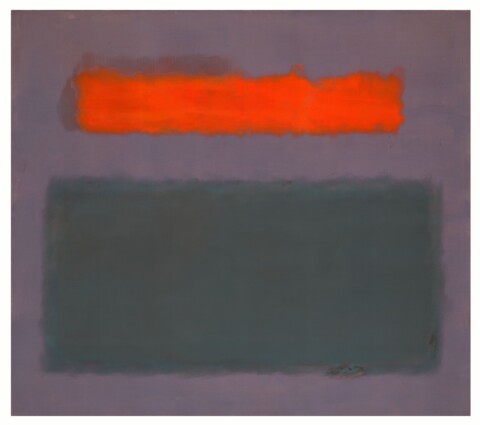
When Mark Rothko arrived in Florence in 1950, the future titan of American Abstract Expressionism found a surprising kindred spirit in the Renaissance. Struck by the devotional frescoes of Fra Angelico at San Marco and the brooding atmosphere of Michelangelo’s Laurentian Library, the encounter prompted him to rethink the spiritual capacity of the canvas. But as his son, Christopher Rothko noted, this influence extended beyond specific artworks; it was the city’s broader atmosphere that got into his father’s head. Rothko effectively translated Renaissance principles of geometry and scale into the postwar New York art scene.
The Inspiration: The cloisters of the Convent of San Marco.
It was here where Rothko first encountered the work of Fra Angelico, was mesmerized by how Angelico used color to create a sense of “enclosure” and sanctity. This directly shaped his later masterpieces — most notably the Seagram Murals — transforming his paintings from mere objects of observation into immersive, spiritual environments designed to be stepped into.
The digital renaissance
If any artist has successfully bridged the 500-year gap between oil paint and pixels, it is Bill Viola. Having moved to Florence as a young artist in the early 1970s, Viola served as the ‘tecnico americano’ (American technician) for Maria Gloria Conti Bicocchi at Art/Tapes/22. It was here where he encountered pioneering video works of artists like Nam June Paik, Bruce Nauman, and Vito Acconci, all of whom had a profound effect on the artists’ legacy. But those contemporary encounters weren’t the only things to make a mark on his work; Viola was deeply inspired by the city’s religious iconography, aspects of which he later incorporated into his own digital work.
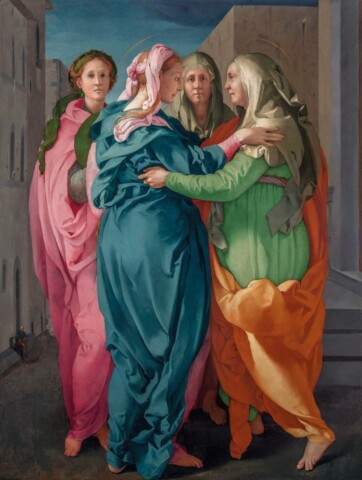
The Inspiration: Pontormo’s The Visitation (located in nearby Carmignano)
Viola’s famous work, The Greeting, recreates this Mannerist masterpiece—found in a small church just outside Florence—in extreme slow motion. His encounter with the painting during his time in Tuscany prompted a digital reimagining that brought the heights of 16th-century emotional drama into the modern gallery.
The spiritual mirror
Known as the grandmother of performance art, Balkan artist Marina Abramović has spent five decades using her own body as both canvas and laboratory. In 2018, she became the first woman to have a major retrospective across the entirety of the Palazzo Strozzi. For Abramović, the Renaissance period is more than a collection of paintings, but a repository of universal human gestures — pain, devotion, and surrender.
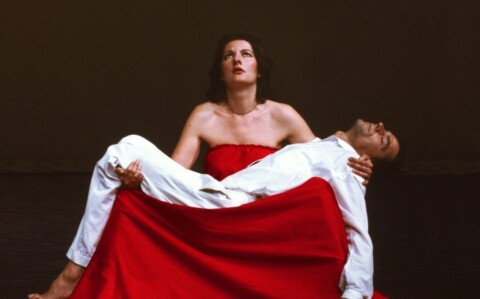
The Inspiration: Michelangelo’s Bandini Pietà at the Museo dell’Opera del Duomo
In her piece Anima Mundi, Abramović draws directly from the Vesperbild tradition, cradling her partner’s body in a pose that mirrors the Virgin holding the fallen Christ. By engaging with Michelangelo’s Pietà Bandini — a work the master carved for his own tomb — Abramović transforms a 500-year-old symbol of faith into a living testament of human connection. Where Michelangelo sought to immortalise his devotion in marble, Abramović uses the ephemeral heat of the human body to demonstrate how the themes of the Renaissance are still very much alive.
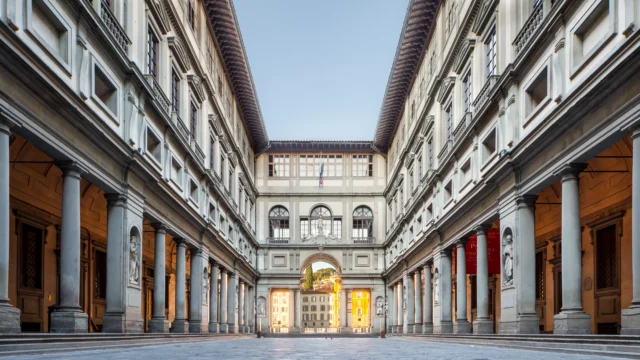
Florence is no longer just a destination for the Uffizi or the Accademia. While the city remains the cradle of the Renaissance, the Tuscan capital has successfully pivoted into a vibrant hub for contemporary dialogue. Today, cutting-edge institutions and private collections host global masters of the 21st century, offering a sharp, modern contrast to the city’s many ancient masterpieces.
So, if you are looking to explore the Florence contemporary art scene, don’t miss these essential galleries…
Palazzo Strozzi
Palazzo Strozzi is Florence’s premier venue for large-scale contemporary ‘takeovers.’ By inviting icons like Ai Weiwei, Marina Abramović, and Jeff Koons to install works within its 15th-century courtyard and grand halls, Strozzi creates a direct bridge between historical architecture and avant-garde thought.
Museo Novecento
Located in the ancient Leopoldine cloister, Museo Novecento is dedicated to Italian art of the 20th and 21st centuries. It offers a sophisticated, chronological journey through modern masters, while its rotating temporary exhibitions spotlight the most influential voices in the current international art world. It is the best place to understand the evolution of Italian modernism.
Roberto Casamonti Collection
For an intimate encounter with global icons, the Casamonti Collection (housed in the Palazzo Bartolini Salimbeni) is a hidden gem. This private collection features a staggering array of modern and contemporary powerhouses — including Miró, Basquiat, Warhol, and Boetti.
GO DEEPER WITH THIS TIME TOMORROW
At This Time Tomorrow, guests are invited to discover the rich artistic legacy of the city from the comfort of your residence. Alongside Jeremy Boudreau, Head of Art at the British Institute of Florence, this one hour introduction to Florence’s art and architecture will trace the development of the city as a Roman cast rum right up to its 15th-century Golden age.
Explore some of our exclusive local experiences, or discover our art-filled residences for your next creative escape.
Feeling inspired? Dive into the art of Moroccan calligraphy with Daifallah Noureddine…
We publish a newsletter every month. Subscribe to receive the next one.
Last modified: Wed, Apr 8, '26