Book a stay
Please choose your options...

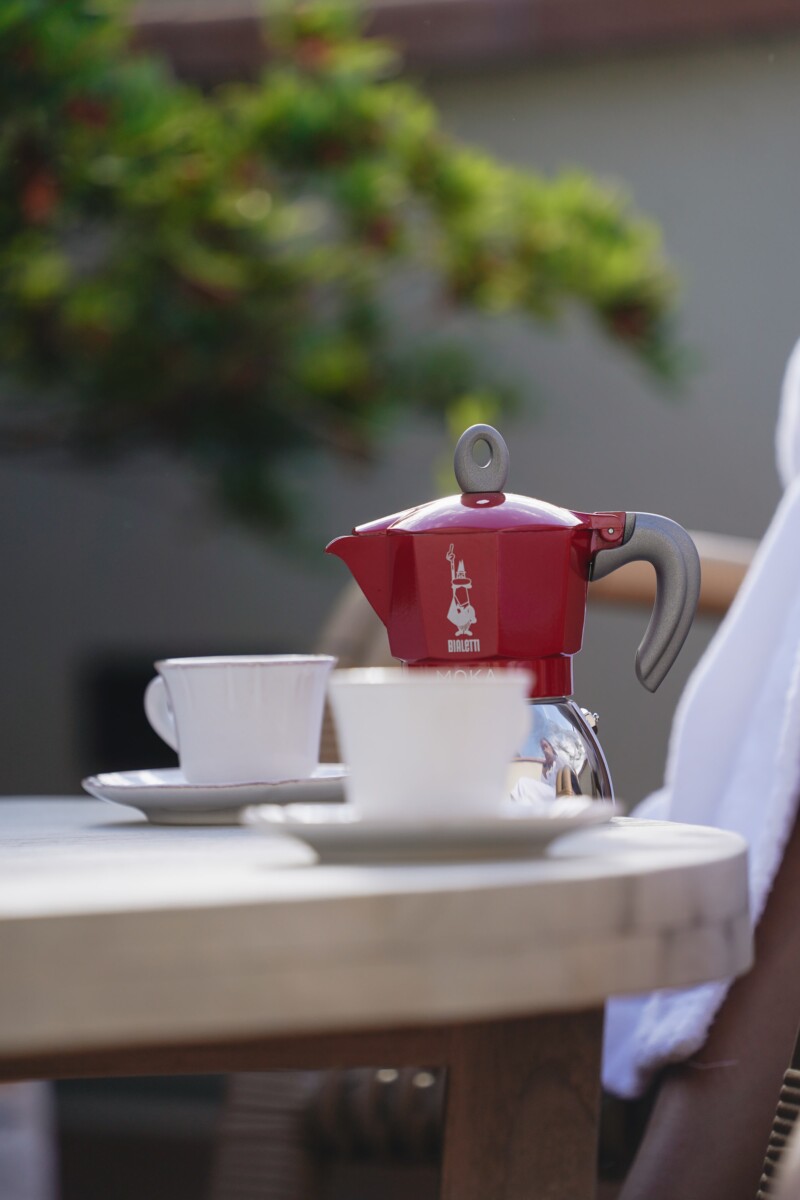

If there’s one sound that defines a typical Italian morning, it’s the gurgling crepito of a Moka pot atop the kitchen stove. Italians are famously dogmatic about their coffee, and for good reason — after a century of fine-tuning the ritual, they really do know best. Since its invention nearly a hundred years ago, the Moka pot has evolved into much more than a functional tool; it is a global design icon and arguably the ultimate ‘Made in Italy’ mascot.
Some surveys suggest that up to 90% of Italian households own one of these stovetop staples, with over 300 million units sold since the 1950s. But why, you might ask, in an era of instant convenience and high-tech automatic machines, does this low-fi device continue to prevail? Partly, it’s the ritual — the tactile process of filling the basket and waiting for that pressurised whistle. More importantly, it’s a matter of identity, representing a defiant commitment to a slow, democratic luxury that a plastic pod simply cannot replicate.So, whether you are looking to master your Moka technique, or curious about the history of the ‘little man with the mustache,’ this guide covers everything you need to know about the world’s most famous octagonal pot.
Designed in 1933 by Alfonso Bialetti, the Moka Express was a feat of Art Deco engineering. Before its invention, espresso was a public luxury, confined to coffee houses equipped with massive, steam-powered machinery. Replicating that high-pressure extraction at home was technically impossible until Bialetti found inspiration in an unlikely place: the ‘lisciveuse’, a primitive laundry-washing machine.
Bialetti’s aluminum pot mimicked the functionality of those washers while its voluptuous eight-sided silhouette was famously modeled after his wife’s silhouette — broad shoulders, small waist, a pleated skirt and one hand on her hip. Arriving during a period of economic depression, the Moka flourished as a cost-effective alternative to the cafe, allowing Italians to brew their beloved morning beverage for pennies on the stove.
In the post-war era, this modest machine democratised the bar experience. By turning a public indulgence into a private ritual, it transformed coffee into a cornerstone of domestic life. Beyond reshaping daily consumption habits, the Moka fundamentally recalibrated the Italian palate, too. It produced a dense, acerbic brew that has since become the gold standard for Italian coffee, as well as the fragrant wake-up call for generations of Italians to follow.
Making coffee in a Moka pot is a science, but many people get it wrong by “burning” the beans. Four basic elements; the water, the coffee, the heat and the Here is the authentic way to do it:
The Water: With pre-heated (but not boiling) water, fill the base up to the middle of the valve.
The Coffee: Use a medium-fine grind (slightly coarser than espresso). Fill the filter basket completely but — crucially — do not tamp it down.
The Heat: Place the moka pot on a low flame. High heat creates a bitter, metallic taste.
The Pour: As soon as the coffee starts to gurgle and the flow turns pale/golden, remove it from the heat. The residual steam will finish the job without burning the brew. Stir the coffee in the upper chamber with a small spoon then pour.
Pro tip: Always clean thoroughly between uses, but avoid using dish soap, which can strip the patina that improves flavour and taint the flavour of future brews. Warm water works just fine!
At This Time Tomorrow, we invite guests to live like a local, through curated experiences that cut to the heart of Italian life, and spaces which encourage cultural immersion. That’s why, instead of your run-of-the-mill coffee machine, you’ll find a Moka pot in each of our Florence residences — allowing you to brew your first taste of la dolce vita the moment you wake up.
Seeking a deeper taste of Italy? Explore the hills of Chianti with Alessandro Gallo of Castello di Albola, or take a look at our live-like-a-local Florence experiences
Last modified: Fri, Mar 6, '26