Book a stay
Please choose your options...
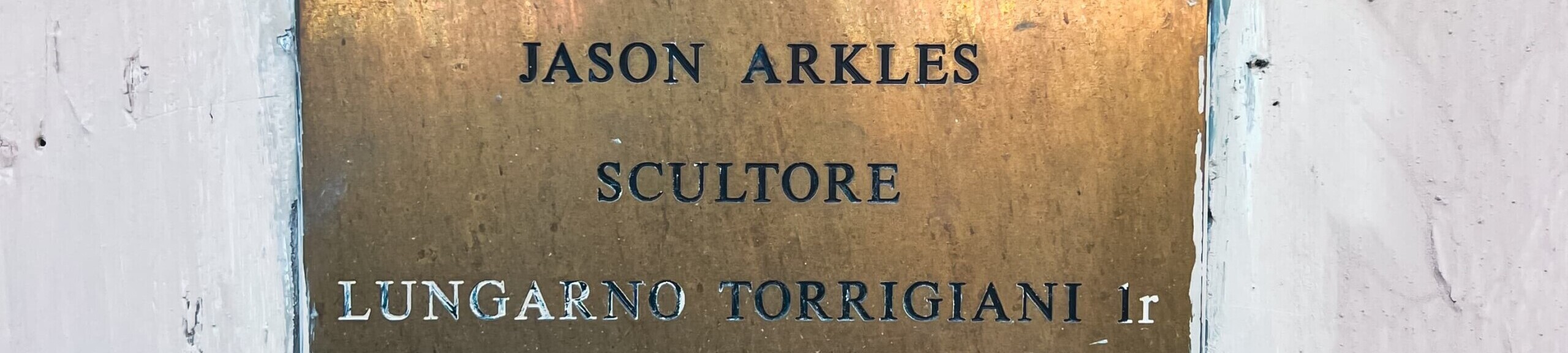

Florence has produced more sculptors per square kilometre than any city in human history. Jason Arkles works here anyway — finding space in a conversation that seven centuries of stone have not yet closed. We spent an afternoon in his studio.
Q1. Florence is saturated with sculpture — the weight of it is almost physical. How do you work alongside that without being absorbed by it, or does the pressure become part of the material?
Never have I felt the abundance of sculpture in Florence to be overwhelming in the way this question is posed. Pressure? There is none. I am not in competition with past masters any more than I am with contemporary masters. Living or dead, they are not competition, they are compatriots, part of the brotherhood. The abundance of sculpture here provides me with a feeling of solidarity, the feeling that I am doing something worthwhile — that I am a small part of a large tradition and I am fortunate to take part. My life makes more sense in Florence than almost anywhere else. More places should be like Florence.
Q2. There is a difference between looking at a sculpture and understanding it through your hands. What does making things with stone tell you that thinking about stone never could?
It is impossible to understand the enormity of the craft of carving until you have done it, from start to finish. Beyond the meaning and purpose of the work of art per se, each marble sculpture is an accomplishment, a triumph of human endeavour akin to training for and running a marathon. Once one learns the craft, one can appreciate the choices made by other sculptors in their works. Some choices may seem minor or indifferent, but they can add days or weeks of labour to a piece. Making the more laborious or difficult choice shows how much the sculptor cared about the idea conveyed by that choice.
Q3. Which single work in Florence — ancient, Renaissance, or contemporary — do you return to most often, and what does it still give you each time?
The panels in the Bargello made by Lorenzo Ghiberti and Filippo Brunelleschi for the competition for the Baptistery doors. Two brilliant sculptors working with the same form and content yet resulting in different ideas — these panels are in conversation with each other in a delightful way. But you have to know the story behind them. As easy as it is to dwell on the physical aspects of sculpture, my interest lies in sculpture as a vehicle for the communication of ideas, values and stories.
Q4. Most visitors look at a sculpture from the outside. What are they missing, and what would you want them to feel rather than see?
Sculpture is meant to be looked at from the outside, of course. If the viewer is missing something, there are a few possible reasons. Either the sculptor did a poor job of communicating the meaning of the work, or — more usually — the viewer lacks the full context for the creation of the work in the first place. Context is everything. If you don’t know why a sculpture was made, then it devolves merely to decoration, a pretty thing to look at. Sculpture is a vehicle for an idea. Look for the idea.
We organise a private session with Jason in his studio — a candid conversation about what it means to make things with stone in a city built from it, or hands-on with a chisel — followed by a private walk through the sculptures in Florence that have stayed with him longest, and why. A This Time Tomorrow exclusive; arranged through our Curator Eric.
We publish a newsletter every month. Subscribe to receive the next one.
Last modified: Mon, Jun 29, '26