Book a stay
Please choose your options...

The chefs behind Santabarbara Desco & Cucina on opening an Italian-Asian kitchen in one of the world’s most codified culinary cities, how Florence received them, and the gastronomic wine bar they’re about to open closer to This Time Tomorrow.

Lorenzo & Alessio, Chefs & Owners
Santabarbara Desco & Cucina works at the intersection of Italian and Asian culinary traditions, in a city that holds its food culture with considerable conviction. We spoke to chefs and owners Lorenzo and Alessio.
A restaurant exists to restore you.
Q1
Florence is one of the most deeply codified culinary cities in the world — the bistecca must be this thick, the ribollita must rest overnight, the crostino made with chicken livers and nothing else. Your cooking comes from completely different references. What does it mean to cook here, and how has Florence received you?
Florence’s cuisine is codified, but only to a point. Italian cooking is less regional than personal — it can change from household to household. Crostini alone: some use only chicken livers, others add spleen, some use spleen exclusively. The same is true of bistecca and countless other dishes. There are rules, but within them there’s real room for the personal.
We enter that tradition without following it to the letter. Our first objective is always genuine deliciousness. We almost always build in what we call a “kick” — an unexpected, slightly disruptive element that stays coherent with the dish. It should surprise without overwhelming, almost embracing everything else on the plate. Our tasting menus let guests choose their own direction — toward the familiar and traditional, or toward something further from what they’d expect.
Opening here was a real challenge; the city remains deeply attached to its culinary traditions. Our strength was probably that we never tried to be traditional at all costs — instead we brought the experience we’d built over the years, together with the ideas of everyone working alongside us.
It was complicated at first, but the response has been wonderful. Over two years, a kind of natural selection has happened: people who understand and appreciate what we do come back; people looking for something else simply realise it isn’t their restaurant. What matters most is that nobody ever feels out of place. Even someone who walks in out of curiosity can choose a shorter menu and leave thinking, “Perhaps not my kind of restaurant, but a good experience.” That matters to us too.
Q2
The Italian and Asian culinary traditions work from very different premises — one built on the ingredient in its simplest form, the other on transformation and layering. Where do you find that tension productive, and where do the traditions simply refuse to speak to each other?
What fascinates me most about Japanese cooking is its relationship with ritual — doing the same thing your whole life in pursuit of perfection. Tamagoyaki, the exact temperature of rice, dashi made with kombu and katsuobushi added at precise moments. There’s extraordinary discipline behind apparently simple things.
Ingredients matter enormously in Italian cooking too, but how we treat them is far freer. Take ragù: some brown the meat, some don’t — every family has its own method.
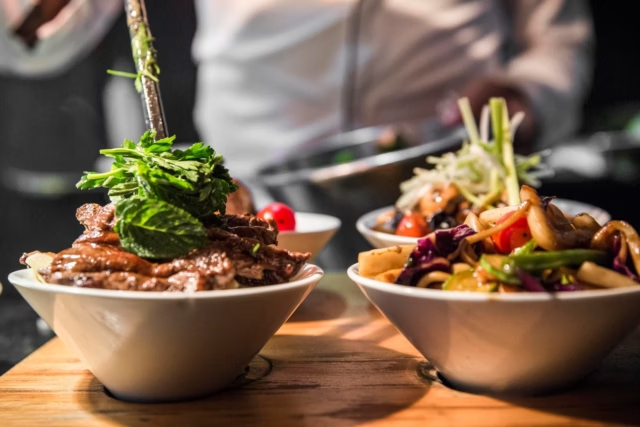
Where do the two meet? In flavour, first of all. The umami of Parmigiano and the umami of Japanese broths. Or XO sauce, from Hong Kong, which we also use — dried scallops, shrimp, intense flavours that make you want another bite. That’s where the dialogue starts: when very different food cultures speak through a shared sensation.
Where they struggle is in their relationship with rules. Traditional Japanese cooking can be extremely structured; Italy allows much more freedom of interpretation. Paradoxically, I see more in common between Japanese and French cuisine — French cooking is highly codified, its stocks, techniques, pâtés and terrines governed by precise methods, often taught formally. France and Japan can meet through shared discipline and technical rigour; Italy keeps a different kind of freedom.
Q3
Which dish has surprised even you by how well it worked — a combination or preparation you weren’t sure about until it reached the table?
Our dishes usually stay on the menu only two weeks, so any single dish is a moving target — but one recent one genuinely surprised us. A raviolo del plin, the traditional Piedmontese shape, filled with figs, Gorgonzola and almonds, paired with a soup inspired by tom kha gai — coconut milk, spring onion, curry, fresh coconut, mussels.
When we first thought of it, we said: let’s see if this actually works. Even the first time it left the kitchen we weren’t fully convinced. Then we worked the details — a little Sherry vinegar for the filling’s acidity, the exact size of the plin to balance pasta against filling. The reaction from guests surprised us; it’s become one of those dishes that genuinely stops people.
On paper it looks like too many elements competing at once. Find the right proportions, though, and suddenly everything finds its place.
Q4
Florentine guests arrive with strong expectations and strong opinions. How has your relationship with the city evolved, and what has it taught you about your own cooking?
Mostly, it’s given us confidence. At first we were nervous — two young entrepreneurs with no large organisation behind us, constantly questioning whether what we were doing was right.
Instinctively, both of us would probably cook even more boldly — we love quinto quarto, offal, intensely saline flavours, sea urchins, oysters. Direct, uncompromising flavours. And yet, even in Florence, the home of quinto quarto, lampredotto, tripe and chicken livers, we’ve had to dial some of that back and make the cooking a little more “democratic,” as we say.
The food has to stay the centre of everything, and it has to excite us — but above all it has to give the guest pleasure. There’s little point in a beautiful, intellectually perfect dish nobody actually enjoys eating. We repeat a phrase often: a restaurant exists to restore you. Our job, first, is to feed people and make them feel good. People come to us looking for creativity too, of course — but ultimately it has to taste good, satisfy, and make you want to come back. The question that matters to us is simple: would I come back? We want the answer to be yes — maybe not tomorrow, but in two weeks, knowing you’ll eat well and probably find completely different dishes.
Location shaped this relationship too. We couldn’t, and didn’t especially want to, absorb the costs of operating inside the UNESCO historic centre. We chose a more residential neighbourhood instead — outside the tourist heart, but still about fifteen minutes on foot from the Duomo. That’s made us a meeting point primarily for Florentines: depending on the season, 85–90% of our guests are Italian, many local. It’s easier to reach — parking at Parterre, the tram, no ZTL, none of the historic centre’s crowds.
At the same time, the location naturally selects the international visitors who find us. They’re rarely tourists who wander past looking for carbonara or a T-bone. The people who arrive here have looked for us — walked, taken a taxi, made the trip deliberately. And they’re often wonderful guests precisely because of that: they chose to be here, they settle in, often take the longer menu and a bottle of wine, look around and see Florentines dining beside them, and understand immediately they’ve found somewhere genuinely local.
Being slightly outside the centre made us a destination. But to be a destination, the cooking has to give people a reason to make the journey.
Q5
You’re about to begin a new project, even closer to This Time Tomorrow. What are you creating?
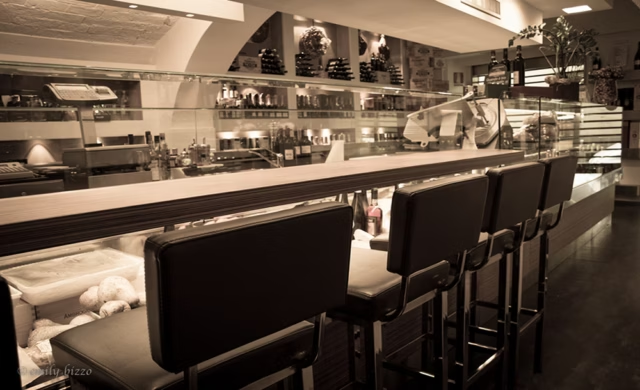
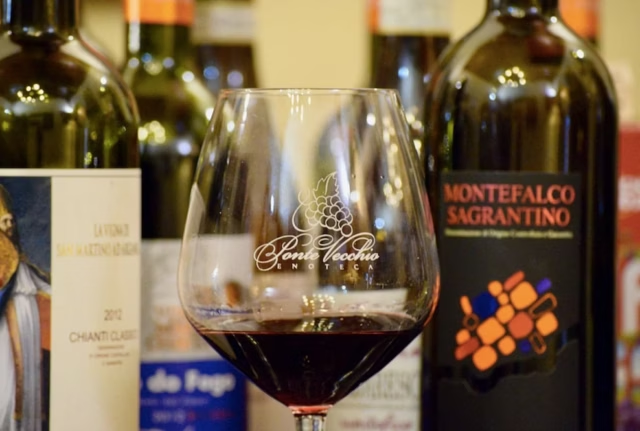
We took inspiration from Spanish wine bars, particularly in the Basque Country, and from the caves à manger of Paris. The idea is a gastronomic wine bar — open from around five in the afternoon until midnight. Come in for a bottle, a glass, or three, always with the option of proper dishes alongside.
We don’t want the classic wine-bar offering of cold cuts and crostini — the food will keep our style and identity. The main kitchen will handle most of the preparation; the new space will have a smaller kitchen for finishing and completing dishes.
We want it to feel much freer — somewhere for an aperitivo, a relaxed dinner, or leaving work at seven thinking, “a glass and something to eat before I go home, so I don’t have to cook tonight.” Mostly walk-in, no online booking, though we’ll stay flexible for people we know or particular situations — we want to keep that spontaneity. It’ll also be an alternative when the restaurant is full: instead of simply turning someone away, we can point them to the wine bar, where there’s still a real food offering.
It connects naturally with guests at This Time Tomorrow — maybe they’ve done a cooking class or had a long lunch and don’t want a full dinner that evening. They can step outside, walk a few minutes, order a good bottle, share something, and relax. We want it young and fresh, with music that sets a mood without intruding — clean, informal, equally comfortable for one glass or the whole evening. It feels like a natural extension of what we already do, at a completely different rhythm.
Know the Story. Live a Chapter.
We publish a newsletter every month.
Share this story
Last modified: Wed, Oct 7, '26