Book a stay
Please choose your options...

Long before it had riads and restaurants, Marrakech had gardens. The city was founded at the edge of the desert precisely so that water could be brought to gardens — not as decoration, but as philosophy. The Islamic garden is a model of paradise, and Marrakech built some of the finest in the world. Very few visitors get to see them.
The Jardin Majorelle is the one everyone visits. Yves Saint Laurent’s cobalt-blue studio, the cacti, the Berber Museum — it is beautiful, and it is always full. It is also the newest of Marrakech’s great gardens, created in the 1920s by a French painter. The city’s real garden heritage is older, quieter, and almost entirely overlooked.
The Menara
Free, open daily

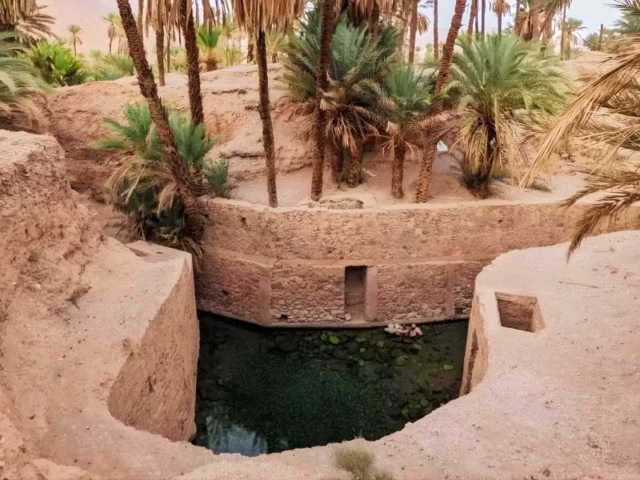
Twelve minutes from the medina, the Menara olive grove covers nearly a hundred and fifty hectares — one of the largest urban olive orchards in the world. It was planted in the twelfth century by the Almohad dynasty and has been continuously productive since. At its centre sits a pavilion above a vast rectangular reflecting basin, fed by the khettaras — the underground irrigation channels that brought water from the Atlas foothills to the city. The combination of water, olives, the Atlas visible on the horizon and near-total silence is difficult to account for in any other terms than the intended ones: this is a space designed for contemplation. Come in the late afternoon, when the light falls across the water from the west. There will be families, children, couples. There will not be tour groups.
The Agdal
Open Friday afternoons

South of the royal palace, the Agdal is the largest historic garden in Morocco — four hundred hectares of orchards, groves and water basins enclosed within walls that have stood since the twelfth century. Pomegranate, orange, apricot, olive, fig and almond trees are organised around two great basins fed directly by the khettara system. The largest basin, the Sahraj el-Hana, stretches for nearly three hundred metres and was used by the Saadian sultans for naval exercises. The Agdal opens to the public on Friday afternoons, when Marrakchis come in numbers to picnic under the fruit trees.
The Jardin Secret
Ticketed

Inside the medina, a short walk from the souks, the Jardin Secret is the most recently restored of the city’s great gardens — a nineteenth-century riad garden returned to its original two-part form: an exotic garden with palms, bamboo and tropical plantings, and an Islamic garden of geometric form with a central water channel and flowering plants organised around the four quadrants of the traditional char bagh. The char bagh — literally ‘four gardens’ — is the oldest surviving model of the designed garden: Persian in origin, carried west by Islamic civilisation, refined in Marrakech into its most disciplined expression. The garden is small; the idea behind it is very large.
The Islamic garden, across all its variations, works from a single premise: that water is the organizing principle of life and that beauty is its visible expression. In a city built at the edge of the Sahara, where water has always been earned rather than assumed, a garden is not a luxury. It is a statement about what a city believes it is for.
We publish a newsletter every month. Subscribe to receive the next one.
Last modified: Sat, May 30, '26